By Philipp — Rollbook
How to Study BJJ Like a Pro: The Match Analysis Method
Watching matches isn't studying them. A step-by-step method for analyzing BJJ footage like a high-level competitor — narrow your focus, map the decision tree, find the patterns, and take it to the mat.
On this page
- Why Watching Isn't Studying
- What Match Analysis Actually Is
- Step 1: Pick One Thing to Watch For
- Step 2: Watch in Slow Motion and Rewind Relentlessly
- Step 3: Map the Decision Tree
- Step 4: Find the Pattern Across Matches
- Step 5: Take It to the Mat
- Tools: Where to Watch and How to Take Notes
- Common Mistakes to Avoid
- Ready to Turn Footage Into Progress?
Why Watching Isn't Studying
Most grapplers think they study jiu-jitsu. What they actually do is watch it -- they put on a high-level match, enjoy the action, marvel at a slick submission, and move on having learned almost nothing they can use. Watching is passive consumption. Studying is active work. The difference between the two is the difference between a fan and a competitor who actually gets better from the footage they consume.
The best grapplers in the world treat match footage as a primary training tool, not entertainment. They watch with a pen in hand, a single question in mind, and the rewind button on standby. They break a single exchange down frame by frame, map out every decision and reaction, and then take what they found to the mat to test it. This article lays out that process as a repeatable method -- the same approach used by the analysts and competitors behind every great breakdown you've ever seen. Master it and every match you watch becomes a lesson instead of a distraction.
An overview of why and how to study competition footage as a learning tool rather than passive entertainment.
What Match Analysis Actually Is
Match analysis is the practice of breaking down recorded grappling -- elite competition, your own matches, or your training rolls -- to extract specific, applicable lessons. It rests on one core idea: at the highest level, nothing happens by accident. Every grip, every angle, every reaction is a decision, and decisions can be understood, named, and copied. The goal of analysis is to convert what looks like magic into a sequence of understandable choices you can add to your own game.
Crucially, analysis is not about collecting more techniques. You almost certainly already know more moves than you can reliably hit. Analysis is about understanding why techniques work -- the setups, the timing, the reactions they force -- so that you can apply the handful you already know more effectively. It is the bridge between "I've seen that move" and "I can hit that move on a resisting opponent."
Track every roll — log sessions and techniques for free
Step 1: Pick One Thing to Watch For
The single biggest mistake in studying footage is trying to absorb everything at once. A six-minute match contains hundreds of decisions; your brain cannot meaningfully process all of them in one viewing. Pros solve this by narrowing their focus to one question per watch. Instead of "what happened in this match," they ask something specific: How does this guard player off-balance opponents before sweeping? How does this passer control the hips? What does this competitor do every time they get to the back?
Choose a question that connects to a problem in your own game. If you keep getting your guard passed, study how elite guard players recover and re-frame. If your back-takes keep slipping, watch only the seatbelt and hook control of someone famous for finishing from the back. Watch the entire match -- or several matches -- looking only for the answer to that one question. Everything else is noise for now.
Training Tip: Write your question down before you press play, and write the answer down after. "How does she retain guard against pressure passers?" → "Keeps a frame on the far shoulder, recovers to a knee shield before they can flatten her, never lets her hips get pinned." A specific question forces a specific, usable answer. A vague intention produces vague results.
Step 2: Watch in Slow Motion and Rewind Relentlessly
Real grappling happens too fast to learn from at full speed. The detail that makes a technique work -- the exact moment a grip is broken, the half-second a hip turns before a sweep lands -- is invisible at normal playback. This is why every serious analyst leans on slow motion and the rewind button. Slow a key exchange to a quarter speed. Watch it five, ten, twenty times. Each pass, track one layer: first the feet, then the grips, then the hips, then the head and posture.
Most learning happens in the rewind, not the first watch. When you see something work, immediately rewind and ask: what happened in the two seconds before that? The finish is rarely the lesson; the setup that created it is. A submission that looks sudden almost always traces back to a grip established ten seconds earlier or a reaction the winner deliberately provoked. Train yourself to look backward from the result to the cause.
Step 3: Map the Decision Tree
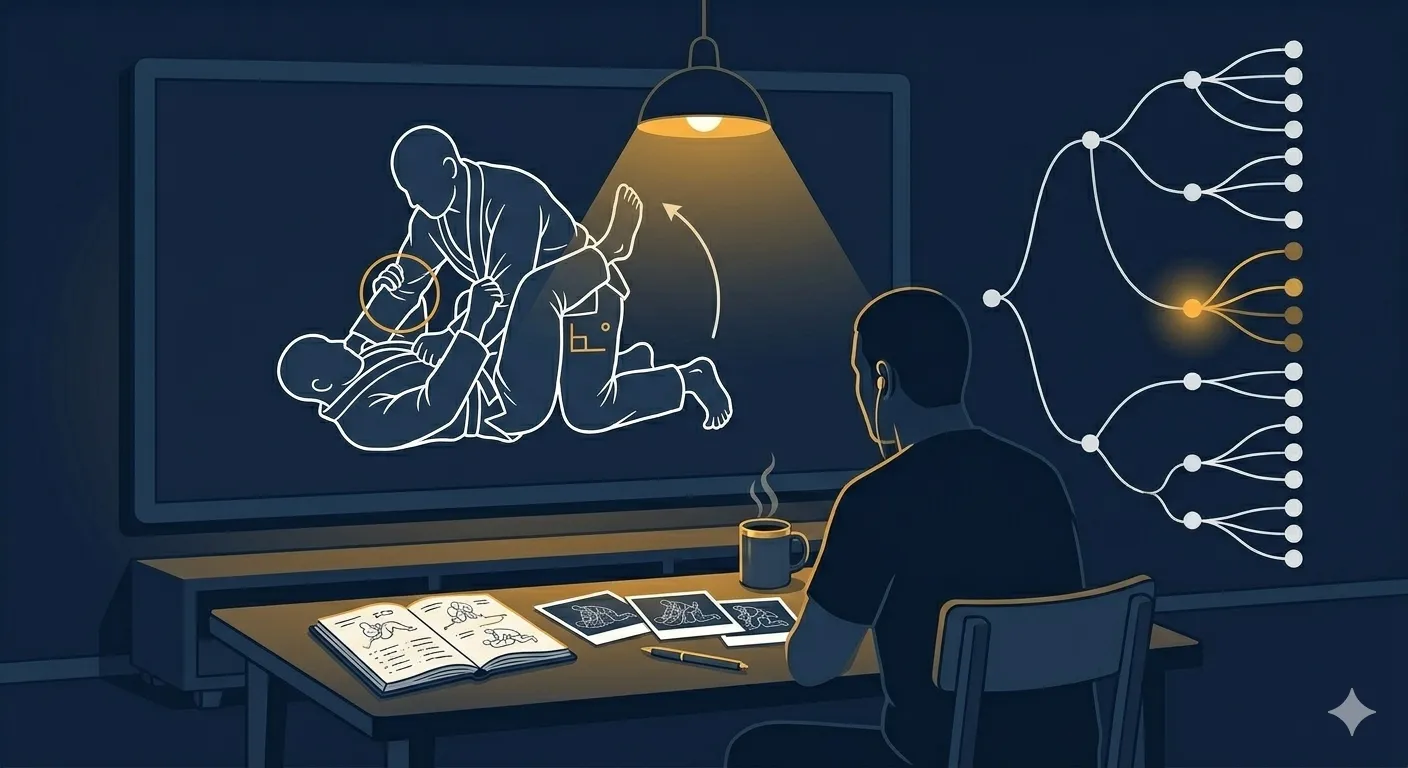
Once you can see the details, the next step is to understand the logic connecting them. High-level grappling is a series of "if this, then that" branches: the attacker tries something, the defender reacts, and the attacker has a pre-planned answer to that reaction. The best way to capture this is to map the decision tree -- literally write out the branches. "If the opponent posts their hand, take the arm drag. If they pull the arm back, hit the sweep instead."
This is exactly how the sport's most systematic minds think. Grapplers like Lachlan Giles built their reputations not just on winning but on explaining the decision trees behind their positions in clear, branching logic -- and studying their breakdowns is one of the fastest ways to learn the method itself. When you map a sequence as a tree rather than a single line, you stop memorizing one technique and start understanding a position. You learn what the attacker does against every common reaction, which is what makes a technique reliable against a resisting opponent who won't cooperate with your favorite move.
An example of competition-footage analysis in practice -- breaking down what makes a position work and the decisions that drive it.
Step 4: Find the Pattern Across Matches
A single match shows you what worked once. A body of work shows you what works reliably. To truly understand a position or a competitor, study multiple matches and look for the pattern -- the thing they do over and over, against different opponents, that keeps producing results. One armbar might be luck or a favorable matchup; the same entry hitting across ten matches against ten different opponents is a system worth stealing.
This is why studying a single great competitor in depth is so valuable. Watch everything a specialist does in their area of mastery and the repeated structure becomes obvious -- the grip they always establish first, the angle they always seek, the reaction they always bait. When you study an athlete's signature position across their whole career, you are no longer learning a move; you are reverse-engineering a system that has been pressure-tested against the best in the world. Patterns are where the real, transferable lessons live.
Step 5: Take It to the Mat
Analysis that stays in your notebook is just trivia. The final and most important step is to test what you found against resistance. Pick the one specific thing you isolated -- a grip, an entry, a reaction -- and drill it, then deliberately hunt for it in your next several rolls. You are not trying to copy the whole match; you are trying to add one well-understood detail to your game and see if it holds up when someone is fighting back.
Expect it to fail at first. The gap between understanding a movement and executing it under pressure is real, and it closes only through repetition. Track what happens: did the entry work? Against whom? What went wrong? This feedback loop -- study, test, observe, adjust -- is the entire engine of improvement. The footage tells you what to try; the mat tells you whether you've actually learned it.
Study Drill: Run a two-week cycle. Week one: pick one question, study three to five matches answering only that question, and map the decision tree. Week two: drill the one detail you isolated and chase it in every sparring round, logging the result each session. At the end, review your notes against your mat results. You'll learn more from this single focused cycle than from months of passively watching highlight reels.
Tools: Where to Watch and How to Take Notes
You don't need expensive software to study well, but a few tools make it far easier. For footage, full competition matches are vastly more useful than highlight reels -- highlights show you finishes stripped of the context that created them, which is the opposite of what you want. Subscription platforms like FloGrappling host full-match archives, and YouTube is full of free full matches and analytical breakdowns from respected coaches. Seek out channels that explain the why, not just replay the action.
For note-taking, keep it simple and searchable. A running document or notebook organized by position ("guard retention," "back attacks," "leg entries") lets you accumulate insights over time instead of forgetting them after each watch. And don't analyze only the pros -- filming and reviewing your own matches and rolls is one of the highest-value forms of study available, because the lessons are perfectly tailored to your actual problems. The same method applies: pick one question, slow it down, find the pattern. Logging what you study and then test on the mat -- in a training journal like Rollbook -- closes the loop between footage and improvement.
How to analyze your own training and competition footage -- the most personally relevant film you can study.
Common Mistakes to Avoid
The first mistake is studying above your level. Analyzing world-championship leg-lock exchanges is fascinating, but if you're a white or blue belt, you'll learn far more from studying fundamental guard retention and basic passing than from elite positions you can't yet contextualize. Match your study to the problems you actually face in training.
The second is collecting instead of applying. It feels productive to watch breakdown after breakdown and fill a notebook with techniques, but if none of it reaches the mat, you've built a library you never read. Study less, but test more. The third mistake is only watching finishes -- the flashy submission is the result of everything that came before it, and the setup is where the actual lesson lives. Train your eye to value the unglamorous grip fight as much as the highlight-reel tap.
Key Takeaway
Studying BJJ like a pro is a discipline, not a pastime. Pick one question, slow the footage down and rewind relentlessly, map the decision tree behind what works, confirm the pattern across multiple matches, and then take a single detail to the mat to test under resistance. Don't collect techniques -- understand systems, and apply what you find. Done consistently, the match analysis method turns every match you watch into measurable progress in your own game.
Ready to Turn Footage Into Progress?
The grapplers who improve fastest aren't necessarily the most talented -- they're the ones who study deliberately and test relentlessly. You already have access to more high-level footage than any generation of grapplers in history. The only question is whether you watch it like a fan or study it like a competitor.
Start a study cycle this week: pick one question, analyze a few matches, isolate one detail, and track how it performs when you take it to the mat. Download Rollbook to log what you study and what you test, keep video links with each technique in your journal, and build the kind of deliberate, feedback-driven practice that turns watching into winning.
Oss!