By Philipp — Rollbook
IBJJF Graduation System: Minimum Age & Time-in-Grade Requirements for Every Belt
How long do you have to spend at each belt? A complete guide to IBJJF graduation requirements -- minimum ages, time-in-grade for blue to black belt, the Worlds exception, and the kids belt system.
On this page
What the IBJJF Actually Requires
Every belt promotion in Brazilian Jiu-Jitsu has two layers: what your professor believes you've earned on the mats, and what the IBJJF recognizes as the minimum standard for an officially valid rank. This guide is about that second layer -- the federation's minimum age and time-in-grade requirements.
A crucial point up front: these are minimums, not entitlements. Hitting the time requirement does not mean you'll be promoted. Your instructor always has the final say. But you cannot be promoted faster than these minimums under IBJJF rules (with one famous exception we'll cover). For the bigger picture of what each belt means, pair this with our BJJ belt progression system guide.
Two things determine eligibility: your age and your time-in-grade (how long you've held your current belt). You have to satisfy both before the IBJJF recognizes the next promotion.
Adult Belt Requirements: The Master Table
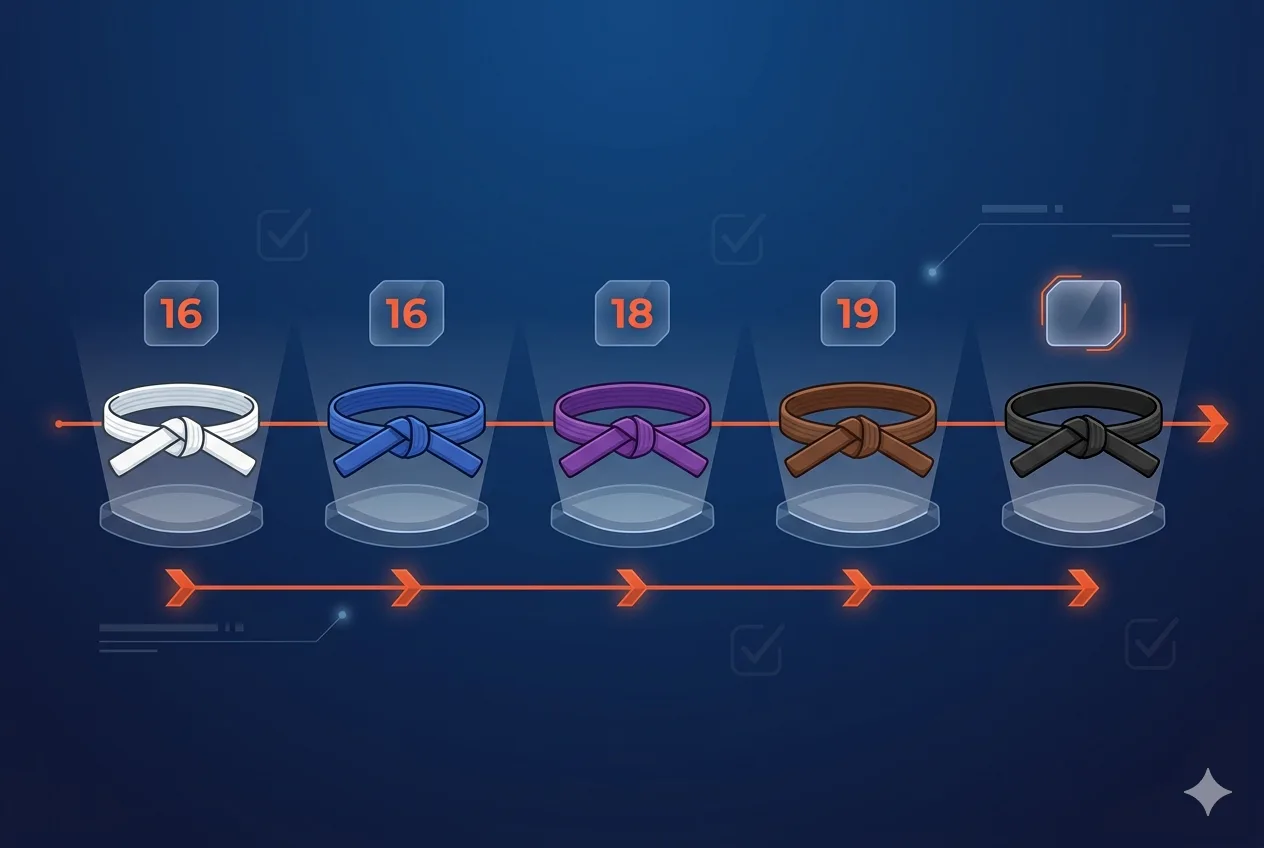
Here is the complete adult and masters progression. These figures come directly from the IBJJF General Graduation System.
| Promotion | Minimum age | Minimum time at previous belt |
|---|---|---|
| To Blue | 16 | -- |
| To Purple | 16 | 2 years as a blue belt |
| To Brown | 18 | 1.5 years as a purple belt |
| To Black | 19 | 1 year as a brown belt |
Pro Tip: Add up the minimums and the fastest possible IBJJF-legal path from blue belt to black belt is about 4.5 years (2 + 1.5 + 1). In reality, the average practitioner takes closer to 10 years to reach black belt. The time requirements are a floor, not a target.
Blue Belt (Minimum Age 16)
The blue belt is the first adult rank. You must be at least 16 years old to receive it -- there are no child blue belts in the IBJJF system. A talented teenager who has trained since age 7 still cannot get a blue belt until they turn 16. For the realistic timeline most people take to earn it, see how long it takes to get a blue belt.
Purple Belt (Minimum Age 16, 2 Years at Blue)
To be promoted to purple, you must have spent a minimum of 2 years as a blue belt. The minimum age is also 16, so the binding constraint for most people is the time requirement.
Brown Belt (Minimum Age 18, 1.5 Years at Purple)
Brown belt requires a minimum of 1.5 years (18 months) at purple belt and a minimum age of 18.
Black Belt (Minimum Age 19, 1 Year at Brown)
The black belt requires a minimum of 1 year at brown belt and a minimum age of 19.
Track every roll — log sessions and techniques for free
The Worlds Champion Exception
There is one official way to bypass the minimum time requirements. As of a 2022 update to the General Graduation System:
If a blue, purple, or brown belt is an adult World Champion, they no longer have a minimum period required at that belt.
This means an adult who wins the IBJJF World Championship at blue, purple, or brown belt can be promoted to the next rank without serving the full time-in-grade minimum at that belt. For example, a brown belt who wins adult Worlds can be promoted to black belt without completing the usual one-year wait at brown. Importantly, the age minimums still apply -- black belt still requires a minimum age of 19. The exception removes the time-in-grade requirement only, and the graduation periods for white and black belts are unchanged. It applies only to adult athletes aged 18 and up.
Why this exists: The IBJJF added the exception because major events only happen a few times a year. An athlete who has clearly outgrown their belt by winning Worlds shouldn't be stuck competing against the rest of the division for another full year. It rewards elite competitive achievement.
Black Belt Degrees
Reaching black belt isn't the end of the graduation system. Black belts earn degrees (stripes):
- 1st degree: A minimum of 3 years of proven IBJJF black belt activity
- Degrees 1-3: Roughly 3 years each
- Higher degrees lead to the red-and-black (coral) belt at 7th degree, the red-and-white belt at 8th degree, and finally the red belt at 9th degree -- reserved for those who reach the pinnacle after decades in the art
The exact higher-degree timelines stretch across a lifetime of teaching and contributing to the sport.
The Kids Belt System
Kids (ages 4-15) follow a completely separate, more flexible system designed for shorter attention spans and steady encouragement. Instead of the adult blue-purple-brown-black ladder, kids progress through belts like white, grey, yellow, orange, and green, each with degrees (stripes).
The IBJJF suggests three graduation cadences academies can choose from:
| System | Promotion cadence | Degrees per belt |
|---|---|---|
| Monthly | Every month | 11 degrees, then promote |
| Triannual | Every 4 months | 2 degrees, then promote |
| Quarterly | Every 3 months | 3 degrees, then promote |
Warning: There's a hard ceiling on kids belts. A 14-year-old cannot receive a blue belt no matter how skilled they are -- they must wait until 16. Most academies keep kids in the youth system until they age into the adult ranks, then begin time-in-grade tracking at blue belt.
Time-in-Grade Is a Minimum, Not a Promise
Pro Tip: Don't count down the days to "your" promotion. The IBJJF minimums only establish when you become eligible. Instructors weigh attendance, technical knowledge, live performance, and competition results. The athletes who get promoted "on time" are the ones who train consistently and let the belt come to them.
What the IBJJF minimums deliberately do not measure:
- Your technical knowledge and skill
- Your consistency and mat time
- Your performance in live rolling and competition
Those are exactly the things your professor evaluates. The federation sets the floor; your coach decides when you've truly earned the next belt above it.
Why Tracking Your Time-in-Grade Matters
Because promotions hinge on documented time at each belt, keeping a clear record of your promotion dates and training consistency genuinely helps -- both for your own motivation and for conversations with your coach. Knowing you've passed the two-year blue belt mark and have trained 4x a week the whole time is a far stronger position than a vague "I think it's been a while."
Official Sources
- IBJJF Graduation System - Official age and time-in-grade requirements
- IBJJF Minimum Graduation Period Update - The World Champion exception
- IBJJF Rules Book & Videos - Full graduation system documentation
Track your time-in-grade with Rollbook. Log your promotion dates, monitor your training consistency, and always know exactly where you stand on the road to your next belt. Start your jiu-jitsu journal today.
Oss!