By Philipp — Rollbook
How IBJJF Ranking Points Work: The Road to Worlds Seeding Explained
IBJJF rankings decide who qualifies for Worlds and who gets seeded. Here's the exact points formula -- standings value, event weight, and season weight -- with worked examples and the black belt qualification thresholds.

On this page
Two Kinds of "Points" in BJJ
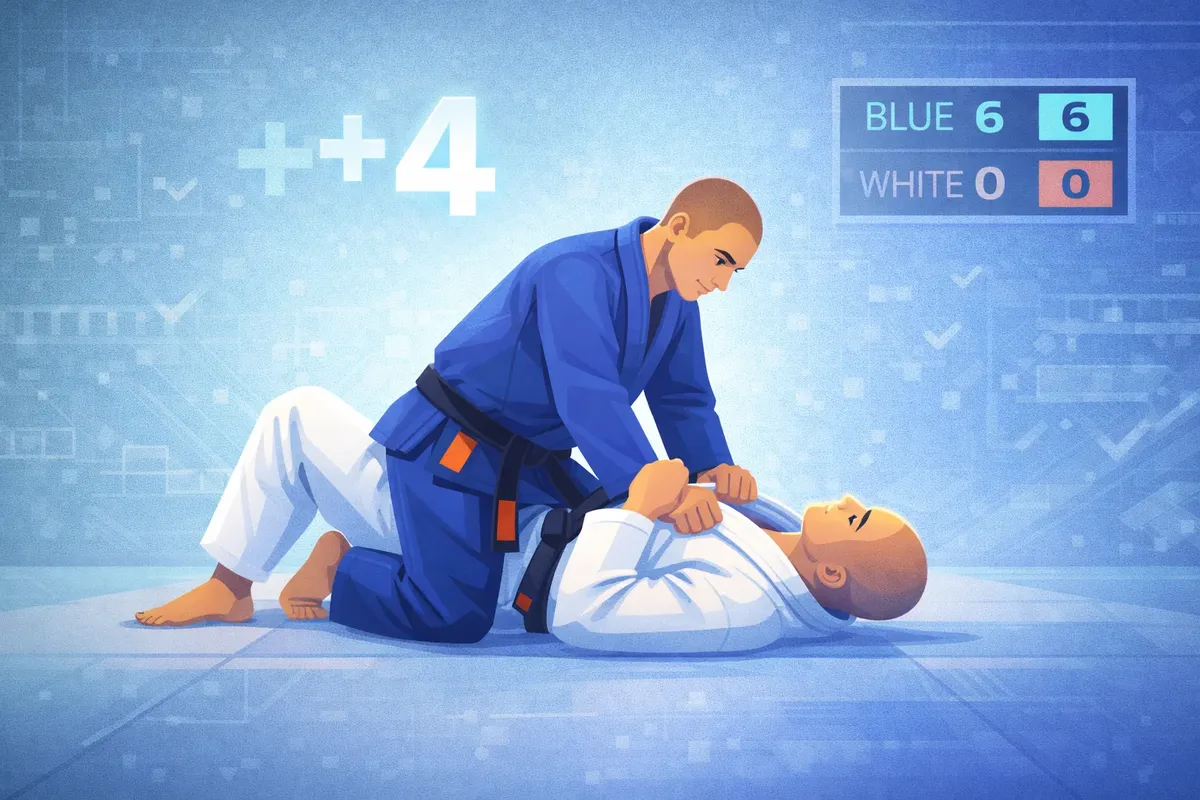
When people say "IBJJF points," they can mean two completely different things. There are match points -- the 2 for a takedown, 4 for the mount -- that decide who wins a single bout. And there are ranking points -- the season-long tally that decides who's the #1 featherweight in the world and who has to qualify for Worlds.
This guide is about the second kind. If you want the in-match scoring, read our IBJJF points system guide. Here, we'll break down exactly how the ranking is calculated, why winning Worlds is worth so much more than winning a local open, and the point thresholds black belts must hit just to register for the biggest events.
Why rankings matter: The IBJJF ranking isn't just for bragging rights. For adult black belts, it's a gatekeeper -- you need a minimum number of ranking points to even enter the World Championship, Pans, and Europeans. Rankings also drive bracket seeding, keeping the top contenders apart in early rounds.
The Ranking Points Formula
Every podium finish (1st, 2nd, or 3rd) earns ranking points calculated with a simple three-part formula:
Ranking points = Standings value × Championship weight × Season weight
Let's break down each piece.
1. Standings Value (Where You Placed)
| Placement | Weight division | Open class |
|---|---|---|
| 1st | 9 pts | 13.5 pts |
| 2nd | 3 pts | 4.5 pts |
| 3rd | 1 pt | 1.5 pts |
Pro Tip: Notice the open class (absolute) values are exactly 1.5× the weight-division values. That's the federation's built-in reward for entering the no-weight-limit bracket -- a Worlds open-class gold is worth 50% more in standings value than a weight-division gold. More on that division in our absolute / open class guide.
2. Championship Weight (How Big the Event Is)
Not all tournaments are equal. The bigger and more prestigious the event, the higher its multiplier. For adult Gi:
| Tier | Event | Weight |
|---|---|---|
| Major | World Championship | 7 |
| Continental | European, Pan, Brazilian National | 4 |
| Regional | Asian Championship | 3 |
| National | American Nationals, BJJ Pro, Pan Pacific, South American | 2 |
| Open | International Opens, National opens | 1 |
This is why Worlds dominates the rankings: a Worlds result is multiplied by 7, while a local International Open is multiplied by just 1.
3. Season Weight (How Recent It Is)
Your ranking counts the current season plus the previous two seasons -- three seasons total. Anything older than that drops off entirely. The most recent season carries the heaviest weight (×3), the one before it ×2, and the oldest still-counting season ×1.
The takeaway: Rankings reward recent performance. A Worlds title from this season is worth far more than the same title three years ago, which has already expired. To stay ranked, you have to keep competing.
Track every roll — log sessions and techniques for free
Worked Examples
Putting the formula together (these are the IBJJF's own published examples):
- 1st place, Medium-Heavy weight, Worlds (recent season): 9 × 7 × 2 = 126 points
- 2nd place, Open Class, Pan (older season): 4.5 × 4 × 1 = 18 points
- 3rd place, Light-Heavy weight, a local Open (current season): 1 × 1 × 3 = 3 points
You can see how lopsided it is. A single Worlds gold can be worth more than dozens of local-open podiums combined. The rankings are deliberately built so that the biggest stage carries the most weight.
What Doesn't Transfer
Ranking points are tracked in separate buckets, and they never cross over:
- By belt and age: Points earned as a purple belt don't follow you to brown. A new black belt starts at zero in the black belt ranking.
- By Gi vs No-Gi: Gi points and No-Gi points are completely separate rankings.
- Across weight divisions (partly): Points from different weight classes in the same belt and age do count toward your overall individual ranking, but they don't move between weight-division-specific rankings.
Warning: Getting promoted resets your ranking -- points are tied to your specific belt and age division and don't carry over, so a new black belt starts the climb from zero. (Some observers argue this is part of why a few competitors delay accepting a promotion, but that's community analysis, not an IBJJF rule.) A change of academy or professor, by contrast, does not affect your points.
The Black Belt Qualification Thresholds
For adult black belts only, the ranking is a hard gate. You must have accumulated a minimum number of ranking points to register for the marquee events:
| Event | Points required (adult black belt) |
|---|---|
| World Championship (Gi) | 80 |
| Pan Championship (Gi) | 40 |
| European Championship (Gi) | 40 |
| Brazilian National (Gi) | 30 |
| World No-Gi Championship | 30 |
| BJJ Pro | 10 |
A few athletes are exempt from these requirements: former Black Belt World Champions, former Black Belt No-Gi World Champions, and athletes who placed 1st in the adult brown belt division at the previous year's Worlds (Gi or No-Gi). For everyone else, the road to Worlds literally runs through the rankings -- you have to earn your way in at smaller events first.
Pro Tip: If you're a black belt chasing a Worlds spot, plan your season around high-weight events. Two or three strong showings at Pans and Europeans (weight 4) build your points far faster than a long string of local opens (weight 1). Map your qualification math before you book flights.
There's Real Money On the Line
At the top, rankings pay out. The IBJJF Adult Black Belt League awards a season-end prize to the highest-ranked male and female black belts. For the 2025/26 season, the awards were $20,000 for 1st, $6,000 for 2nd, and $3,000 for 3rd. The ranking isn't just a leaderboard -- for the elite, it's a paycheck and a Worlds invitation rolled into one.
How This Connects to Your Competition Plan
Even if you're not chasing a world title, understanding the ranking helps you plan a season:
- Prioritize higher-weight events if you want your results to count for more.
- Compete in the current season -- points decay, so consistency matters.
- Consider the open class for that 1.5× standings bonus if you're up for the challenge.
- Track your results so you always know where your points stand relative to qualification thresholds.
For the events themselves, see our IBJJF 2026 schedule and calendar and our Worlds 2026 coverage.
Official Sources
- IBJJF Athlete Ranking Information - The official formula, event weights, and qualification thresholds
- IBJJF Ranking - Live athlete rankings by belt, age, and Gi/No-Gi
- IBJJF Rules Book & Videos - Full competition documentation
Plan your road to the podium with Rollbook. Log your competitions, track your results across the season, and always know where your ranking points stand before the next event. Start mapping your competition season today.
Oss!