By Philipp — Rollbook · Updated October 18, 2026
IBJJF Worlds 2026 Analysis: The Techniques and Trends That Defined It
What IBJJF Worlds 2026 told us about where gi jiu-jitsu is heading — the leg lock crossover, the back-take's enduring dominance, team concentration, and the global youth wave reshaping the black belt ranks.
On this page
- The 30-second version
- Trend 1: Leg locks have gone from controversial to routine
- Trend 2: The back-take is still the king of black belt finishing
- Trend 3: The medals are concentrating at a few super-teams
- Trend 4: The black belt ranks are getting younger and more global
- How to turn these trends into a training plan
- Common questions
- Track the game you're actually building
- Sources
The 30-second version
IBJJF Worlds 2026 didn't just crown champions — it confirmed where competitive gi jiu-jitsu is heading. Four trends defined the weekend: leg locks are now routine at the gi's biggest stage, the back-take and rear-naked choke remain the highest-percentage finish at black belt, a handful of teams (AOJ, Alliance, CheckMat, Soldiers) are concentrating the medals, and a global youth wave — from Kazakhstan to the UAE to a teenage AOJ champion — is reshaping the black belt ranks. Here's what the matches actually showed, and what it means for your own training.
A note on the numbers: IBJJF does not publish official tournament-wide submission statistics, and a complete match-by-match breakdown of Worlds 2026 had not been released at the time of writing. The analysis below is built from the verified results and event reporting, plus the broader 2026 season data where it's been compiled by third parties. Where a figure is cited, the source is linked.
Trend 1: Leg locks have gone from controversial to routine
The clearest stylistic signal at Worlds 2026 came from the colored belt divisions, where some of the most dominant runs were built on foot and ankle attacks. At brown belt, Natã Tença (Atos) won the ultra-heavy division taking every match by submission with foot locks, and Felipe Goulart (AOJ) won light-feather on the strength of repeated ankle locks in a war of a final (FloGrappling Day 1 recap).
That's not an isolated weekend. It tracks a season-long shift: at the 2026 Pans, the straight ankle lock was the second most-used submission across the adult black belt division (16 finishes), behind only the rear-naked choke (17) and ahead of the armbar (14), per the stats compiled in our Worlds preview. The straight ankle lock — the one leg attack fully legal under IBJJF rules at every belt — has crossed over from a no-gi specialty into a core gi finishing tool.
What it means for you: If you train gi and have written off leg locks as "a no-gi thing," the highest levels of the gi game disagree. The straight ankle lock and its entries (especially from de la Riva, single-leg X, and the bottom of leg-drag exchanges) are now table stakes. Learning to attack and defend them is no longer optional.
Trend 2: The back-take is still the king of black belt finishing
For all the attention leg locks get, the highest-percentage path to a black belt submission remains the oldest one in the book: take the back, finish with the choke. The rear-naked choke led all submissions at the 2026 Pans, and the position remains the engine of the sport's most efficient champions — Tainan Dalpra, who won middleweight gold again, has built his entire reign on a relentless pressure-passing-to-the-back game that turns position into points and the choke alike.
The lesson the elite keep teaching is that the back is the position where points, dominance, and the submission all stack on top of each other. You don't have to choose between scoring and finishing — the back-take is both.
What it means for you: If you're building a competition game on a budget of limited training time, back control is the highest-return position to invest in. Four points, a dominant position the rules actively reward, and the single most reliable submission in gi grappling all live in the same place.
Trend 3: The medals are concentrating at a few super-teams
Worlds 2026 was, more than anything, a team story. AOJ had the single best day of the tournament on finals Sunday — Tainan Dalpra, Diego Pato, Cole Abate and Ashlee Funegra all won titles for the academy. Alliance led both the adult male and adult female team races heading into the black belt finals (85 and 36 points respectively after Saturday), with DreamArt, CheckMat, Atos and Soldiers rounding out the contenders (Yahoo/FloSports Day 3 recap). In the final standings, as revised by IBJJF in September, Alliance won the men's title and Atos edged Alliance 46 to 45 for the women's (IBJJF results).
The super-heavy final said it most clearly: both finalists, Vinicius Liberati and Erich Munis, came from the same team (Soldiers). When a single academy can occupy both sides of a Worlds final, the training room has become as decisive as the bracket.
What it means for you: Talent is necessary but not sufficient at the top — training partners are the multiplier. You can't relocate to AOJ, but you can be deliberate about who you roll with: seek out partners better than you in your weak positions, and treat your training room as the asset it is.
Track every roll — log sessions and techniques for free
Trend 4: The black belt ranks are getting younger and more global
The names breaking through were strikingly young and strikingly international. Tarcisio Santos, a black belt for only six months, beat the world #2 at lightweight. Teenage AOJ prodigy Ashlee Funegra won a world title. The Qazaqstan Top Team produced two brown belt world champions in Alinur Kuatuly and Seiilkhan Bolatbek, and the UAE Jiu-Jitsu Team's Khaled Alshehhi beat the #1-ranked Rerisson Gabriel en route to a black belt silver.
For a sport whose elite has long been concentrated in a handful of Brazilian and American academies, the 2026 podiums — with champions and finalists from Kazakhstan, the UAE, South Korea and beyond — point to a genuinely globalizing black belt division.
What it means for you: The talent pipeline is widening and the entry age to the elite is dropping. The flip side: the techniques that win Worlds are more documented and more teachable than ever. The gap between "regional competitor" and "world level" is now a gap of deliberate, tracked practice — not geography.
How to turn these trends into a training plan
Four takeaways, four concrete adjustments:
- Add the straight ankle lock to your gi game — both the attack (from de la Riva and single-leg X) and the escapes. It's legal at every belt and increasingly unavoidable.
- Make back control your highest-priority position — it's the best points-and-submission stack in the sport.
- Audit your training partners — identify who challenges your weakest positions and roll with them on purpose.
- Track what you actually practice — trends only matter if your reps follow them.
That last point is where most well-intentioned plans quietly fall apart. It's easy to decide to drill ankle locks and back attacks; it's much harder to know, eight weeks later, whether you actually did.
Common questions
What was the most-used submission at IBJJF Worlds 2026?
IBJJF does not publish official tournament-wide submission statistics, so there is no certified Worlds 2026 figure. Across the 2026 season, the rear-naked choke and the straight ankle lock were the two most-used black belt submissions (per third-party stats from the Pans), and both featured heavily in the Worlds brackets.
Are leg locks allowed at IBJJF Worlds?
The straight ankle lock (straight foot lock) is legal for all belts under IBJJF rules. Heel hooks and most twisting/reaping leg attacks remain banned in the gi adult divisions. The legal-everywhere status of the straight ankle lock is a big reason it has become so common.
Which team won IBJJF Worlds 2026?
Alliance won the adult male team title and Atos the adult female title. Alliance led both races entering the final day, and Atos moved past it in the women's standings (46 points to 45) when IBJJF revised the results on September 25, 2026; AOJ finished third in both and had the strongest finals-day haul among individual academies (IBJJF results).
What's the biggest trend in competitive BJJ right now?
The mainstreaming of leg locks — specifically the straight ankle lock — into the gi game, alongside the enduring dominance of back control and the rear-naked choke at the highest level. Globalization of the black belt ranks is the other defining 2026 trend.
Track the game you're actually building
Worlds shows you what works at the highest level. The harder question is whether your own training reflects it — whether the positions you say you're prioritizing are the ones you're actually drilling week to week.
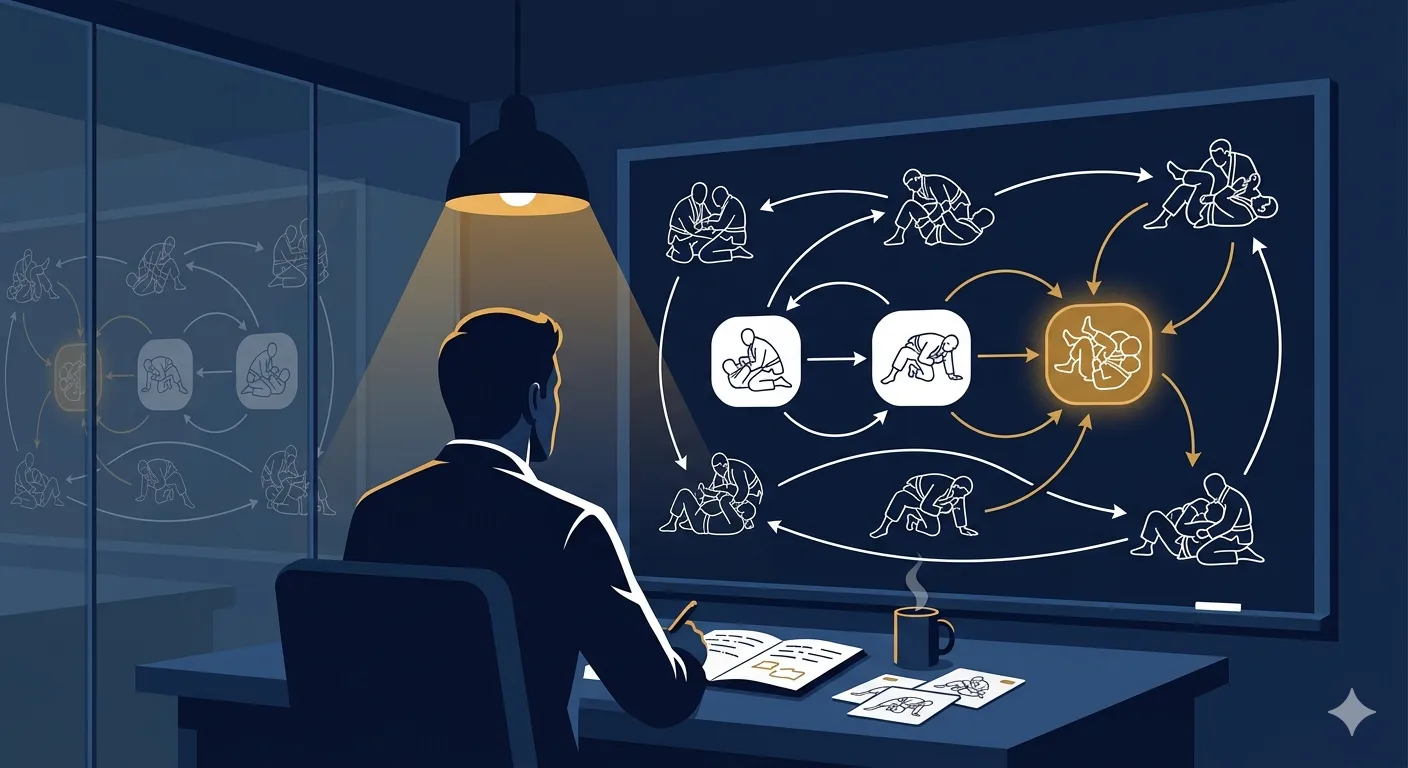
Rollbook closes that gap. Systems let you map the exact sequences these trends point to — your ankle-lock entries, your back-take system — as a tree of positions, moves and your opponent's reactions. Quick Log records each session and the techniques you drilled in seconds, and Time to Revisit flags the techniques you haven't drilled lately. Try Rollbook on your next training block — it's free on iOS and Android.
Sources
- IBJJF Worlds 2026 Day 1 recap (colored belt submissions) — FloGrappling
- Day 3 recap and team standings — Yahoo Sports / FloSports
- Every-division results — FloGrappling
- Final team standings, as revised — IBJJF results page
- 2026 season submission data (cited within) — Worlds 2026 preview & predictions
- IBJJF rules reference — IBJJF rules complete guide