By Philipp — Rollbook
ADCC Rules & Format Explained: Scoring, the No-Points Period & Overtime
ADCC's ruleset is unlike anything in jiu-jitsu: a no-points first half, longer matches, and every leg lock legal. Here's how ADCC scoring, time limits, and the format actually work.
On this page
A Completely Different Kind of Grappling Match
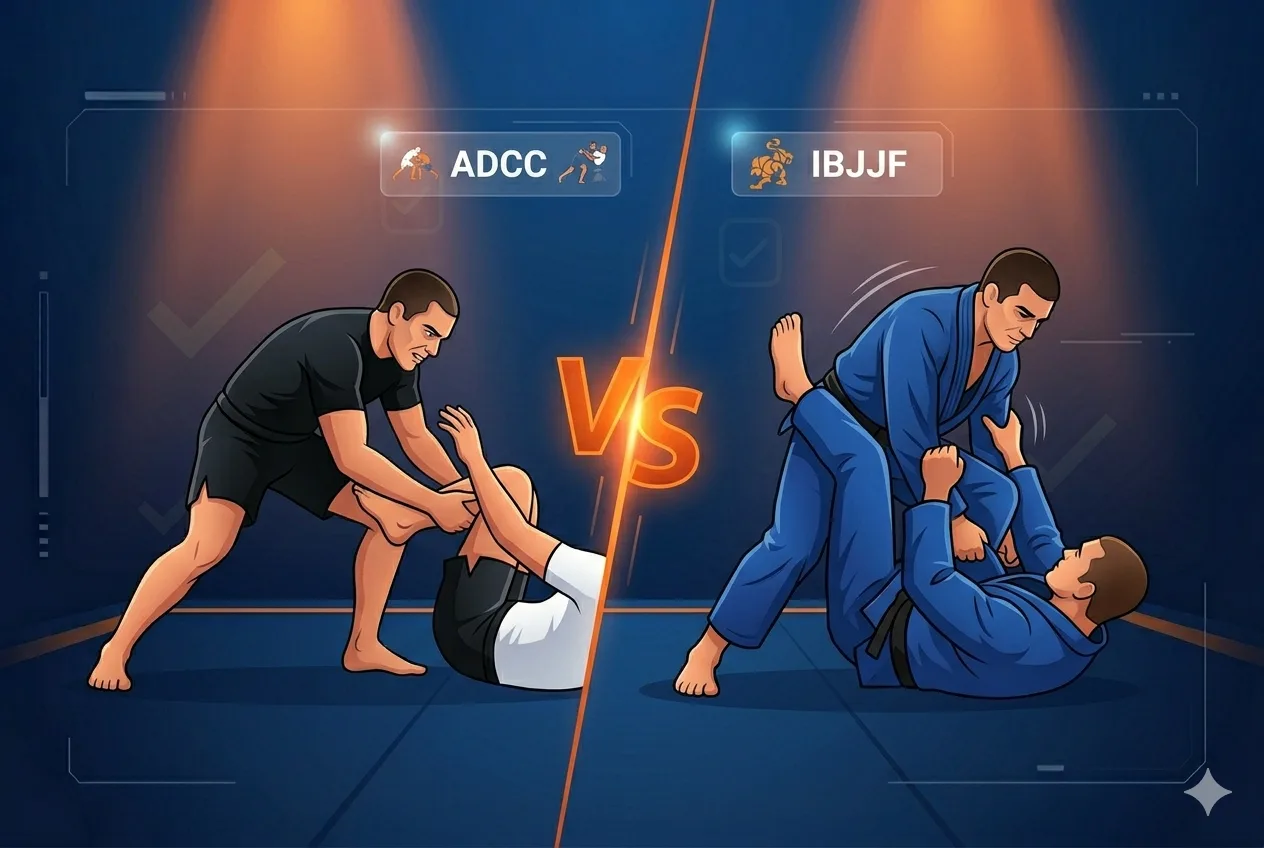
If you're used to IBJJF jiu-jitsu, watching ADCC for the first time can be confusing. The clock runs for ten or twenty minutes, nobody scores for the first half, heel hooks fly freely, and a match can end in a referee decision with zero points on the board. That's all by design.
ADCC (Abu Dhabi Combat Club) is the most prestigious submission-grappling event in the world, held every two years -- and the 2026 World Championship in Kraków, Poland is the next edition. This guide explains exactly how its ruleset works so you can follow the action like an expert. For a side-by-side with jiu-jitsu's main federation, see our ADCC vs IBJJF rules comparison.
The big idea: ADCC rewards aggression and submissions above positional points. By switching points off for the first half of every match, it pushes athletes to hunt for the finish instead of stalling on a small lead.
The No-Points Period: ADCC's Signature Rule
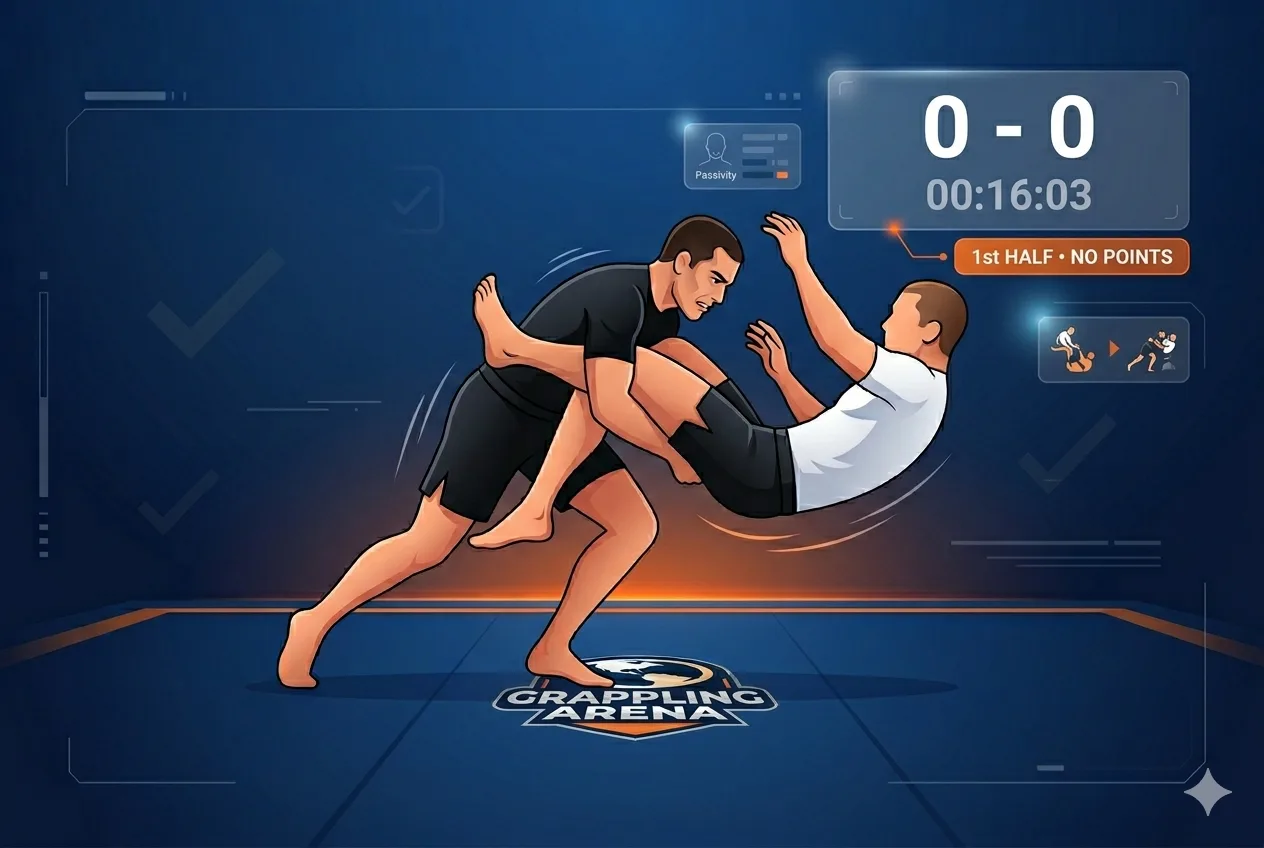
Every ADCC match is split into two halves. In the first half, no positive points are awarded -- only negative points (penalties) can be given. In the second half, points are switched on and scored normally, as they are in any overtime.
The logic: with no points to protect early, athletes are incentivized to attack for the submission rather than score once and stall. It produces the relentless, finish-or-bust pace ADCC is famous for.
Pro Tip: Watch how elite competitors use the no-points period. The best don't coast -- they hunt submissions and set traps, knowing that even without points, a referee decision at the end rewards whoever was more dominant and aggressive.
Time Limits (World Championship)
ADCC matches are long, and they get longer as the stakes rise:
| Round | Regulation | Structure | Overtime |
|---|---|---|---|
| Qualifying rounds | 10 min | 5 min no points + 5 min with points | 5 min (max 1) |
| Finals, Absolute finals, Superfight | 20 min | 10 min no points + 10 min with points | 10 min (max 2) |
At lower-level events (Trials and Opens), the same structure applies on a shorter clock -- qualifying rounds run 6 minutes (3 + 3) and finals 8 minutes (4 + 4).
How You Win an ADCC Match
There are four ways to win:
- Submission -- a tap (physical or verbal), or the referee stopping the match to protect a fighter.
- Points -- being ahead when time expires (points only count from the second half onward).
- Referee decision -- if the match ends with the score tied (including 0-0), the referees award the win based on dominance and aggression.
- Disqualification -- the opponent breaks a forbidden rule.
Track every roll — log sessions and techniques for free
The ADCC Points System
When points are live (second half and overtime), here's the scoring. Every position must be held for 3 seconds and free of submission danger to count:
| Action | Points |
|---|---|
| Clean takedown (lands past the guard) | 4 |
| Clean sweep (ends past the guard) | 4 |
| Guard pass | 3 |
| Back mount with hooks | 3 |
| Takedown (ends in guard or half guard) | 2 |
| Sweep (ends in guard or half guard) | 2 |
| Mount | 2 |
| Knee on belly | 2 |
Notice the structure rewards finishing the action: a takedown that lands straight into a dominant position past the guard is worth 4 -- double a takedown that ends in guard.
Negative Points (Penalties)
ADCC actively punishes stalling and disengagement. You can lose a point for:
- Pulling guard or jumping to a non-standing position and staying down 3+ seconds
- Disengaging -- backing up and avoiding re-engagement
- Passivity (after warnings)
- Fleeing the mat, including to escape a submission
- Shooting a takedown then pulling guard in under 3 seconds
Warning: Guard pulling is penalized in ADCC. This is the opposite of many jiu-jitsu rulesets where pulling guard is a neutral choice. In ADCC, voluntarily sitting down hands your opponent a negative-point advantage -- one reason ADCC features so much more wrestling than a typical BJJ tournament.
Legal and Illegal Techniques
ADCC's submission rules are famously open. Every leg lock is legal for everyone -- including heel hooks, knee bars, and toe holds -- with no belt restrictions, because ADCC has no belt divisions.
Legal:
- All chokes (except using the hand to close the windpipe)
- All arm locks, shoulder locks, and wrist locks
- All leg locks and ankle locks, including heel hooks
- Can opener and twister are permitted
Illegal:
- Neck cranks that trap both shoulders with downward pressure
- Full nelson, crucifix
- Spiking an opponent on their head
- Rolling forward while someone is on your back
- Striking, biting, eye-gouging, hair pulling, small-joint manipulation
- Grabbing the shorts or shirt
- Slamming -- except to escape a submission
This is why ADCC is the leg-lock showcase: with heel hooks legal for all competitors and no belt limits, ADCC is where the world's best leg-lockers operate without restriction. If you're studying the modern leg game, ADCC footage is the textbook. Brush up with our leg locks guide and heel hook defense guide.
Weight Classes and Format
ADCC is an invite-and-qualify event with a small, elite bracket. The World Championship features five men's weight divisions (−66, −77, −88, −99, +99 kg) and three women's weight divisions (−55, −65, +65 kg -- a third was added starting in 2024), plus an Absolute (open weight) for both men and women and a marquee Superfight. Athletes earn their spots through the global ADCC Trials or by direct invitation.
For the full breakdown of the 2026 event -- the brackets, the venue, and the road to Kraków -- see our ADCC 2026 schedule and Kraków championship guide.
Official Sources
- ADCC Official Rules - The authoritative ADCC ruleset
- ADCC Rules & Regulations (ADCC News) - Detailed scoring, time limits, and penalties
- ADCC Official Website - Event info and divisions
Studying the ADCC game? Track the techniques you're drilling -- leg entries, wrestling, submission chains -- with Rollbook. Build the well-rounded game ADCC rewards. Start your free trial today.
Oss!