By Philipp — Rollbook · Updated November 7, 2026
The Berimbolo: How It Works, Who Invented It and How to Stop It
The berimbolo is the spinning back take from de la Riva guard that took over gi competition in the 2010s. How it works, the disputed story of who invented it, how the Mendes and Miyao brothers made it famous, the counters, and the IBJJF reaping rule.
On this page
What Is the Berimbolo?
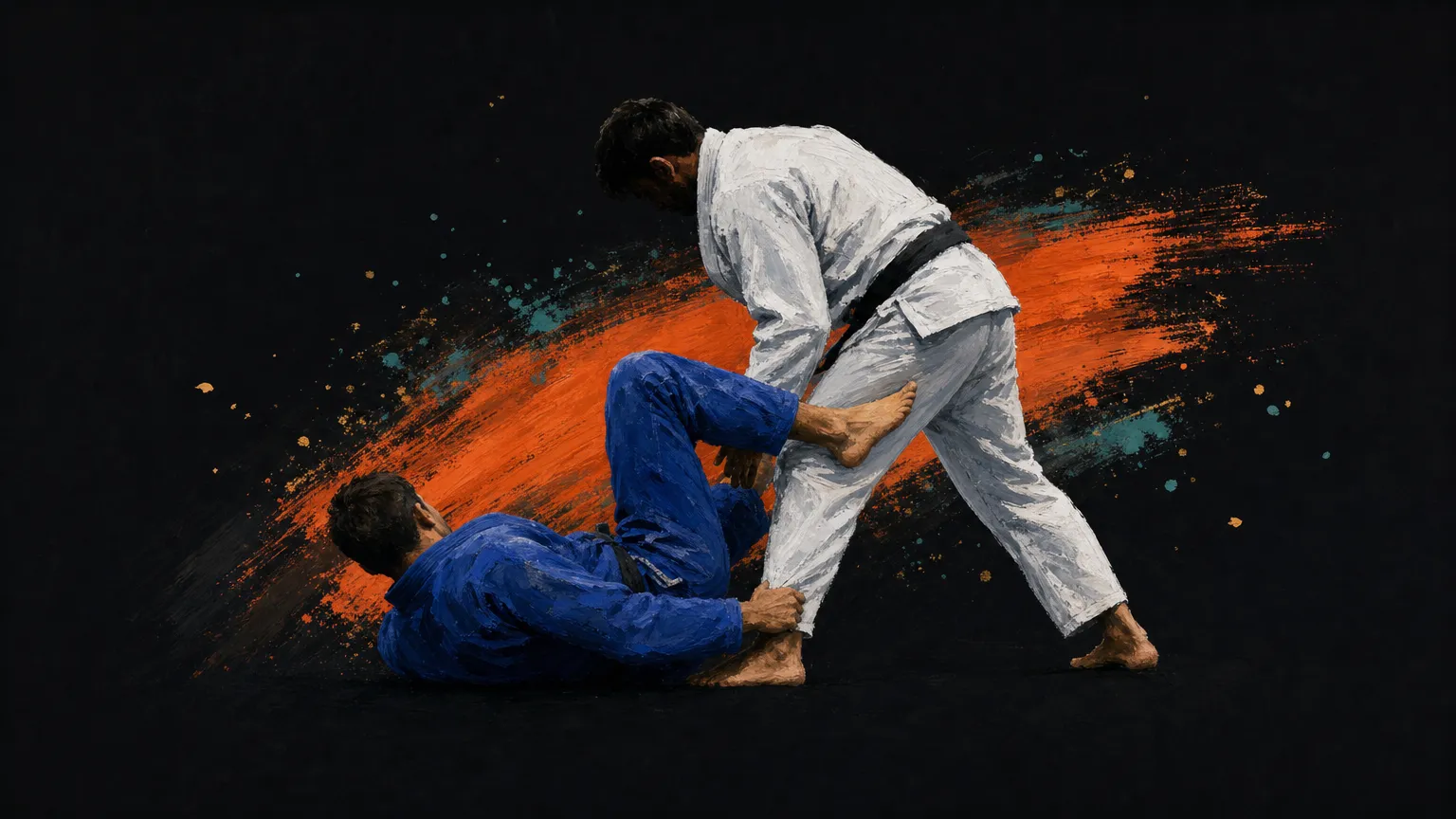
The berimbolo is a back take from de la Riva guard. With your de la Riva hook on your opponent's front leg and a grip on their far leg, you off-balance them, then spin upside down under them, onto your shoulders, and come out behind them. It can also end as a sweep.
It looks like a trick, but it was built for a real problem. Samuel Braga, the black belt most often named as its creator, says his opponents had started stepping back to defend his de la Riva sweeps, so he began rolling under them while controlling their arm.
The berimbolo in one sentence: an upside-down spin from de la Riva guard that takes your opponent's back.
Who Invented the Berimbolo?
The answer depends on who you ask:
- Samuel Braga is the name you'll hear most. He told Graciemag he came up with it as a purple belt in 2003; a later BJJ Heroes interview places it in a 2002 World Championship final instead. He used it in the 2005 Worlds black belt light-featherweight final against Gabriel Moraes and won gold.
- Marcel Ferreira, at Carlson Gracie's academy around 1993, is named as the father of the berimbolo in a 2012 Tatame article, as BJJ Heroes reports. André Galvão disagreed: what Ferreira did was a different move, "the helicopter", he said.
- Older judo footage from the 1950s Kosen judo scene shows a similar back take from the top, as BJJEE reported in 2020.
So no single inventor is proven. What's clear is who made it famous.
How the Mendes and Miyao Brothers Made It Famous
Rafael and Guilherme Mendes used the berimbolo relentlessly to win tournament after tournament from about 2010, and Graciemag called the technique performed "par excellence" by them. Braga says the name caught on in the US after the Mendes brothers used it around 2010. In the 2009 World Championship final, Guilherme Mendes beat Braga himself, on advantages.
Joao and Paulo Miyao pushed it further around 2011 and 2012. Braga credits them with modernizing the berimbolo and adding the crab ride and the twister hook to it. Paulo Miyao met Guilherme Mendes in the 2014 World Championship final.
According to BJJ Heroes, the name itself came from André Galvão, and it's a Brazilian Portuguese colloquialism for a scramble.
How the Berimbolo Works
- Set your de la Riva guard. Your outside leg hooks their front leg from the outside, one hand holds that ankle, and the other grips their far leg or their belt.
- Off-balance them. Pull and kick so they fall back toward their hip or sit down.
- Invert. Roll onto your shoulders and spin under them, keeping your de la Riva hook to turn their hips with you.
- Come out behind them. Finish the spin with your chest toward their back, then put your hooks in and take a seatbelt grip.
From there you have back control, worth 4 points under IBJJF rules once you hold it with both hooks in for 3 seconds, and the rear naked choke or bow and arrow choke to finish.
Safety: Inverting puts your weight on your shoulders and neck. Learn to roll over your shoulders safely before you drill the full spin, and go slowly with a partner who knows it's coming.
How to Counter the Berimbolo
Defenders usually try one of three things, and each has its own counter, as Nick Salles and Daniel Maira, black belts under Mikey Musumeci, showed for FloGrappling:
- Posting a hand on the mat to keep their distance from the spin.
- Falling onto the far shoulder for stability, which leaves them open to an easy sweep instead.
- Falling flat on the back so there's no back to take. The twister hook answers it: it torques the defender's knee so their hips can't stay flat on the mat, so apply it carefully in training.
The same article shows Musumeci at the Worlds: when Alexssandro Sodré's hand post failed and he shifted his weight to stop the back take, Musumeci took the easy sweep and then rolled for the back again. Defending early is easier than defending late: stop the de la Riva hook and the grip on your far leg, and the spin never starts. Carlos "Esquisito" Holanda of CheckMat told Graciemag his own antidote relies on a precise grip on the pants and an inside hook on the leg.
Is the Berimbolo Legal in IBJJF?
The IBJJF rule book never names the berimbolo, so the spin itself is legal. What can make it illegal is a reaping entry. The rule book defines knee reaping as putting your thigh behind their leg and your calf over their body above the knee, with your foot past the midline of their body and their foot trapped between your hip and armpit. BJJ Heroes says berimbolos with a deep underhook on the shin became a reaping foul. Knee reaping is banned except for adult brown and black belts in no-gi (since January 2021), and referees judge each case. See our IBJJF illegal techniques by belt for the full table.
Berimbolo FAQ
What does berimbolo mean?
According to BJJ Heroes, the name is Brazilian Portuguese slang for a scramble, and André Galvão gave it to the technique.
Who invented the berimbolo?
It's disputed. Samuel Braga is most often credited and told Graciemag he created it as a purple belt in 2003 (BJJ Heroes dates it to the 2002 Worlds); others name Marcel Ferreira at Carlson Gracie's academy in the 1990s.
Who made the berimbolo famous?
The Mendes brothers, Rafael and Guilherme, from around 2010, and the Miyao brothers, who according to Braga added the crab ride and the twister hook.
Is the berimbolo good for beginners?
It's an advanced move: it needs a solid de la Riva guard and comfortable inversions first. Learn the guard and the back take before the spin.
Sources
- The berimbolo (BJJ Heroes): how it works, the creator claims, the Mendes and Miyao brothers, the name and the reaping foul
- Samuel Braga interview (BJJ Heroes, 2019): why he started rolling, the 2005 Worlds final and the Miyao additions
- Samuel Braga on the berimbolo (Graciemag, 2012): created as a purple belt in 2003
- The berimbolo and the Mendes brothers (Graciemag, 2012): the Mendes brothers and Carlos Holanda's details
- Berimbolo in 1950s Kosen judo (BJJEE)
- Counters to common berimbolo defenses (FloGrappling): the three defenses and their counters
- Guilherme Mendes (Wikipedia): the 2009 and 2014 World Championship finals
- IBJJF Books & Videos: the rule book (version 6.1) and its knee reaping rule
Drilling inversions? Log your berimbolo reps in your Rollbook technique journal, with notes on the rolls where it worked. Rollbook is free on iOS and Android.
Oss!