By Philipp — Rollbook · Updated November 7, 2026
BJJ Positions: Every Jiu-Jitsu Position, Ranked From Best to Worst
The positions of Brazilian jiu-jitsu in the order that matters: back control, mount, knee on belly, side control, guard, half guard and turtle. What each one is, what IBJJF scores for it, and how to escape the bad ones.
On this page
What a Position Is
A position is where your body is in relation to your opponent's: on top or underneath, in front or behind, with or without their legs in the way. Jiu-jitsu is built on the order of positions. The better your position, the easier it is to control your opponent and finish them, and the harder it is for them to do anything to you.
That's why the classic advice is "position before submission". Get to a dominant position and hold it first, then go for the choke or the joint lock. The IBJJF rules follow the same logic: you score points for reaching and holding positions, while nearly finishing a submission earns at most an advantage.
Positions in one sentence: on top, the back, mount, knee on belly and side control are where you want to be; underneath, the guard is where you fight back; everything else is a scramble between them.
The Positional Hierarchy
This is the usual order, from the best place to be to the worst. IBJJF points mostly follow it. The exception is knee on belly: it scores 2, while the guard pass that gets you to side control scores 3.
- Back control: you're behind them with your hooks in. 4 points.
- Mount: you sit on their torso. 4 points.
- Knee on belly: your knee is on their stomach or chest. 2 points.
- Side control and north-south: you pin them across the chest after passing their legs. Passing the guard into either scores 3 points.
- Inside their guard or half guard, on top: neutral. You usually have to pass their legs before you can pin them.
- Guard, underneath: also neutral. A good guard player sweeps and submits from here.
- Half guard, underneath: you have one of their legs trapped, but they're halfway past.
- Turtle: on your knees and elbows, one step from having your back taken.
- Under side control
- Under mount
- Your back taken: the worst place to be.
Read it from both sides. Every top position on the list is someone else's bottom position, and the bottom half of the list is where your escapes start.
Back Control
You're behind your opponent with your chest on their back and your feet hooked inside their thighs. Your arms usually hold a seatbelt grip: one arm over their shoulder, one under their armpit, hands clasped across their chest. Many consider it the most dominant position in grappling, because they can't see your attacks or reach you with theirs.
Under IBJJF rules, back control scores 4 points when both heels are between their thighs, your legs aren't crossed and you've trapped at most one arm, not above their shoulder line, held for 3 seconds. A body triangle, crossed feet or both arms trapped earn only an advantage.
From here come the rear naked choke, the bow and arrow choke and the armbar.
Mount
You sit on your opponent's torso, facing their head, with your knees on the mat on both sides of them. Mount is one of the best positions in jiu-jitsu: your weight pins them, and you can attack their arms and neck while they can barely reach you.
IBJJF scores it 4 points when you're clear of their half guard with both knees, or one knee and one foot, on the mat, and you've trapped at most one arm, as long as the leg trapping it doesn't reach past their shoulder. The common variations:
- High mount: up on their chest, sometimes with an arm pinned under your knee.
- Low mount: on their stomach. Too low, and they can sit up and escape to guard.
- S-mount: one knee up beside their head, a classic armbar setup.
- Technical mount: one knee and one foot down, on an opponent who has turned onto their side.
The armbar, the cross collar choke and the arm triangle are the classic finishes. Our Roger Gracie mount breakdown shows the position at its best.
Knee on Belly
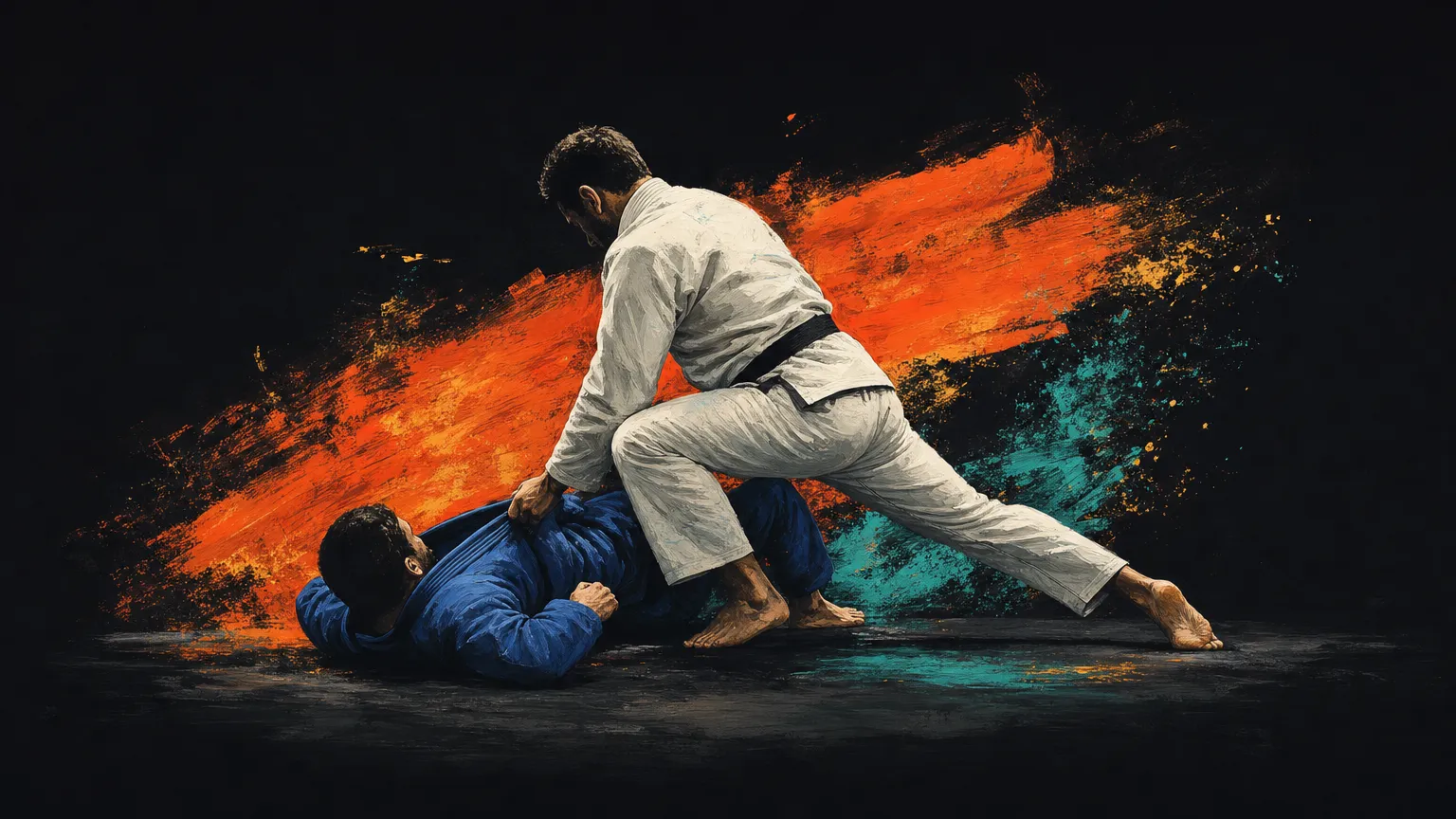
You put your knee or shin on your opponent's stomach, chest or ribs, with your other leg out wide for balance. It's less stable than mount, but it's mobile: you can float between knee on belly, mount and side control as they try to escape, and they often push on your knee and give you an armbar.
IBJJF scores knee on belly 2 points when your other knee stays off the mat and you hold it for 3 seconds while they're on their back or side. With your other knee down, it's only an advantage.
Side Control and North-South
Side control is the pin you land in after passing the guard: you lie across their chest from the side, chest to chest, with their legs out of the way. Brazilians call it cem quilos, 100 kilos. It has several versions:
- Kesa-gatame (scarf hold): you sit on your hip beside them, an arm around their head and their arm clamped under yours.
- Twister side control (reverse scarf hold): you face their legs instead of their head.
North-south is the pin from above their head: you lie on top of them, chest to chest, with your head toward their legs. It sets up the north-south choke and the kimura.
Under IBJJF rules, the guard pass that gets you to side control or north-south scores 3 points once you hold it for 3 seconds. Our guard passing guide covers how to get there.
Guard
The guard is the bottom position where your legs stand between you and your opponent. The IBJJF defines it that way: using one or more legs to stop them from reaching side control or north-south. A good guard isn't a bad position. You can sweep from it, which scores 2 points, and many submissions start there.
- Closed guard: your legs wrapped around their waist with your ankles crossed. Our closed guard attack system covers its sweeps and submissions.
- Open guard: any guard without your ankles crossed, using your feet, knees and grips instead. Butterfly, de la Riva, spider, lasso and X-guard are open guards. Our glossary of guards defines each one.
Half Guard
You're on your back or side with one of their legs trapped between yours. The IBJJF treats half guard as a guard: it blocks them from side control and north-south. It sits between a full guard and side control, so it can favor either player.
From the bottom, you either recover a full guard, come up with an underhook, or go underneath them into deep half guard to sweep. Variations include the Z-guard, also called the knee shield, and the lockdown.
Turtle and Other In-Between Positions
- Turtle: on your knees and elbows, curled up to protect your neck. It's usually a stop on the way to recovering guard or standing up. Stay too long and they take your back.
- Front headlock: you control their head from the front while they're bent over or turtled. Guillotines, anacondas and darces start here.
- Standing: every match starts on the feet, and takedowns score 2 points.
- Leg entanglements: positions such as ashi garami and 50/50, where both players' legs are tangled and leg locks are the threat. See our leg lock guide.
How to Escape the Bad Positions
Escaping is the first thing most beginners need, because new students spend most of their time underneath. The basic escapes:
- Under mount: trap one of their arms and the foot on the same side, then bridge and roll them over (the upa); or shrimp out and put a knee back in to get to half guard or guard (the elbow-knee escape).
- Under side control: frame on their neck and hip to make space, then shrimp and bring your knee back in to recover guard, or turn to your knees.
- Under knee on belly: frame on their hip and shrimp away, or turn into them. Pushing their knee with straight arms invites the armbar.
- Your back taken: fight their hands first to protect your neck, then work your back to the mat, clear a hook and turn to face them.
- In turtle: don't let them sink their hooks in. Sit out, roll to guard or stand up.
Frames, shrimping and bridging do the work in almost every escape. Our BJJ terms glossary explains each movement.
Positions and IBJJF Points
Every position has to be held for 3 seconds to score:
- 2 points: a takedown, a sweep, or knee on belly.
- 3 points: a guard pass to side control or north-south.
- 4 points: mount or back control.
Our IBJJF points guide covers advantages, penalties and the scoring details. Other rulesets score differently: see our ADCC rules guide.
BJJ Positions FAQ
What are the basic positions in BJJ?
Back control, mount, knee on belly, side control and north-south on top; closed guard, open guard and half guard underneath; and turtle and standing in between.
What is the most dominant position in BJJ?
Most grapplers say back control. Your opponent can't see your attacks, you control them with your legs and arms, and the IBJJF scores it 4 points, the same as mount.
Does the body triangle score points in IBJJF?
No. IBJJF back control needs your heels between their thighs with your legs not crossed. A body triangle or crossed feet scores only an advantage.
What should beginners learn first?
How to survive and escape the bottom positions: mount, side control and the back. You'll spend a lot of time there in your first months, and the escapes lead straight back to guard.
How many positions are there in BJJ?
There's no fixed number, because every position has variations. The ten or so on this page are the ones every class is built around.
Sources
- IBJJF Books & Videos: the rule book (version 6.1, June 2024), articles 4.1 to 4.6 on takedowns, guard passes, knee on belly, mount, back control and sweeps, and the definitions of guard and half guard
- Back mount (Wikipedia): hooks and why it's considered the most dominant position
- Mount (Wikipedia): high, low and S-mount
- Knee-on-stomach (Wikipedia): how it's used and the armbar from it
- Side control (Wikipedia): kesa-gatame and twister side control
- North–south position (Wikipedia): the pin and its judo holds
- Half guard (Wikipedia): its place between guard and side control, and its variations
Learning the map? Tag the techniques you drill by position in your Rollbook technique journal and see which positions you neglect. Rollbook is free on iOS and Android.
Oss!