By Philipp — Rollbook · Updated November 2, 2026
Combat Jiu-Jitsu Explained: Rules, Palm Strikes and Overtime
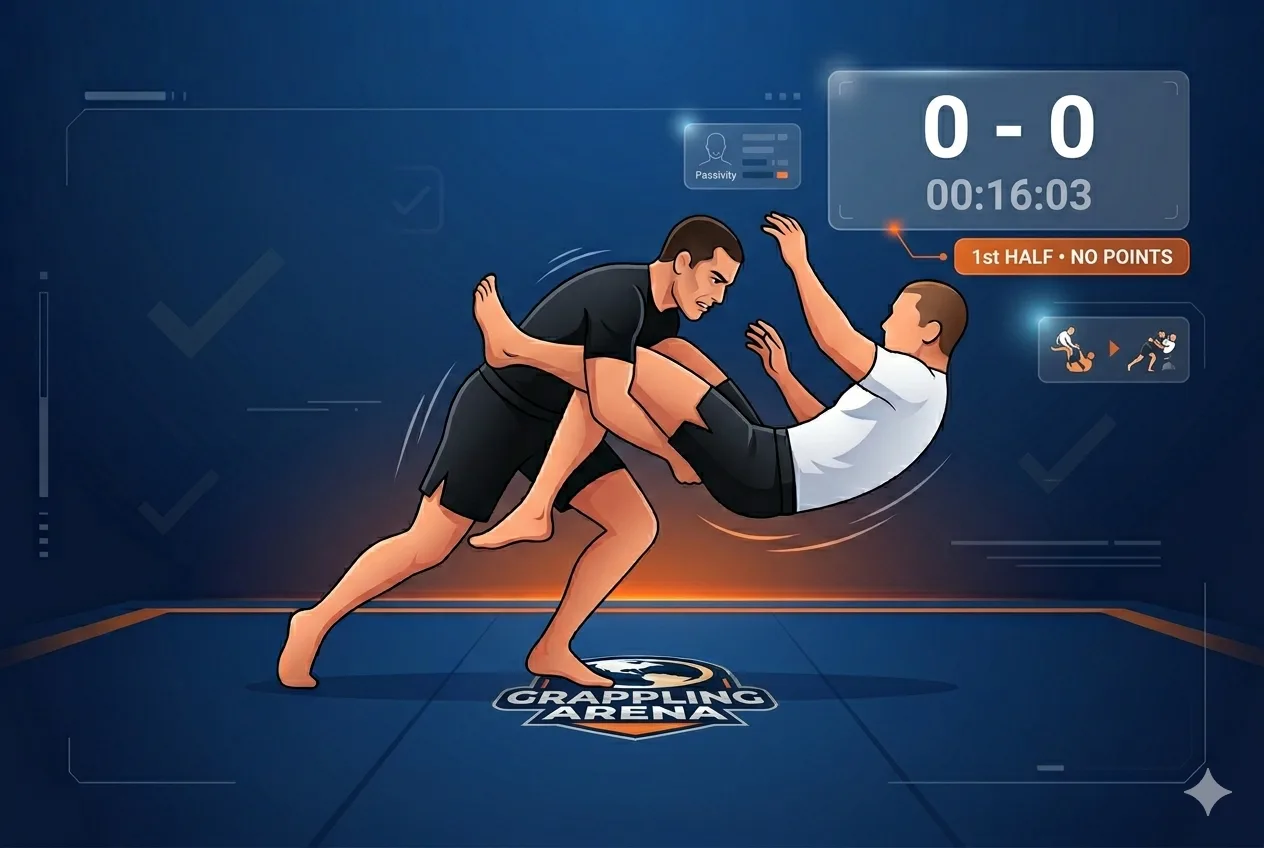
Combat jiu-jitsu is no-gi grappling with open-palm strikes once someone is on the ground. When you can strike, how a match is won, how EBI overtime works, and where CJJ came from.
On this page
- What Is Combat Jiu-Jitsu?
- Combat Jiu-Jitsu Rules at a Glance
- When You Can Strike: The Grounded Rule
- How a Combat Jiu-Jitsu Match Is Won
- EBI Overtime: How Ties Are Broken
- Legal and Illegal Techniques
- Oregon's Version: Get-Down Rule, Purgatory and Weight Classes
- Combat Jiu-Jitsu vs BJJ vs MMA
- Combat Jiu-Jitsu Events: From EBI 11 to EBI 26
- Where to Train Combat Jiu-Jitsu
- Combat Jiu-Jitsu FAQ
- Official Sources
What Is Combat Jiu-Jitsu?
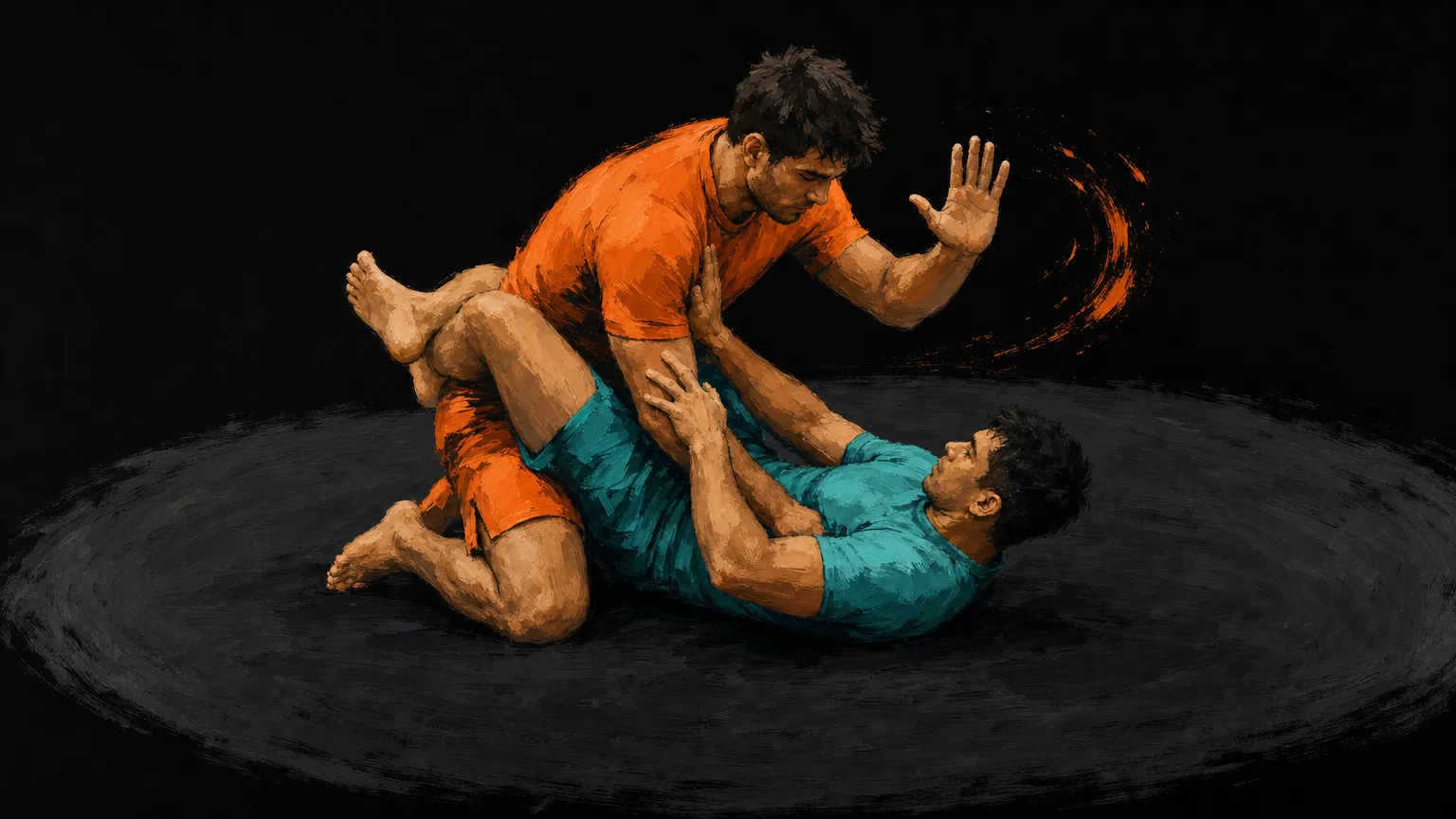
Combat jiu-jitsu (CJJ) is no-gi submission grappling with one big change: once either athlete is on the ground, both may hit each other with open palms, to the body and to the face. There are no points, no advantages and no judges. A match ends in a submission, a stoppage from strikes or a disqualification. If 10 minutes pass without one, EBI overtime decides the winner.
Eddie Bravo, the founder of 10th Planet Jiu-Jitsu, built CJJ on top of his submission-only Eddie Bravo Invitational (EBI). He announced it in January 2017 and ran the first CJJ bracket at EBI 11 that March. His goal was grappling that looks more like a real fight: when sitting on your back can earn you a slap, guard pulling and stalling on the bottom stop being free.
The big idea: In sport jiu-jitsu, lying on your back in guard costs you nothing. In combat jiu-jitsu, the moment you sit down you can be slapped. Guard players have to control posture and grips, and top players can use strikes to pry a defense open, a little like MMA but with bare hands and no closed fists.
Combat Jiu-Jitsu Rules at a Glance
| Rule | Combat jiu-jitsu |
|---|---|
| Strikes | Open palms only |
| Targets | Body and face |
| When | Someone is grounded |
| Standing | Grappling only |
| Match length | 10 minutes |
| Wins by | Submission, KO/TKO, DQ |
| Points, judges | None |
| Tiebreaker | EBI overtime |
| Heel hooks | Legal for pros |
| Attire | No gi, gloves or shoes |
The details below come from two places: Eddie Bravo's description of CJJ when he launched it, and the rules the state of Oregon adopted in 2023, the most complete written version of the ruleset. Oregon also adds a few rules of its own, covered further down.
When You Can Strike: The Grounded Rule
Strikes are legal only while at least one athlete is grounded. Once that happens, both athletes may strike: the fighter on top can slap down, and the fighter underneath can slap back. While both are standing, it's grappling only.
Oregon's rules spell out what grounded means. An athlete is grounded when:
- both hands, palms or fists, touch the floor, or
- any part of the body other than the soles of the feet touches the floor, with one exception: a single knee doesn't count.
So both knees down, a hip, the buttocks, the back or the head on the mat all make an athlete grounded. Sitting to guard grounds you at once; dropping one knee in a takedown shot doesn't.
Every strike must be with the open palm. Under Oregon's rules any other strike while someone is grounded is a foul, and so are strikes to the back of the head or the spine (the tailbone included), throat strikes and any attack to the groin.
Palm strikes still end fights: At the first Combat Jiu-Jitsu Worlds in November 2017, Vagner Rocha won the lightweight bracket by TKO with palm strikes. Oregon sets a medical suspension of at least 30 days after a TKO and 60 days after a knockout, with no contact training in that time.
How a Combat Jiu-Jitsu Match Is Won
A professional CJJ match is one 10-minute round. Oregon allows shorter amateur bouts, but no shorter than 6 minutes. In regulation there are four ways to win:
- Submission: a tap or a verbal tap.
- Technical submission: the referee stops the match to protect an athlete caught in a submission.
- Knockout or TKO: strikes leave an athlete unable to continue, or the referee stops a one-sided fight.
- Disqualification: for a serious or repeated foul.
There are no points and no judges' decisions. If nobody wins in 10 minutes, the match goes to overtime.
Fouls and stalling don't cost points either. Under Oregon's rules the referee instead adds up to one minute of "ride time" to the offender's overtime clock, and a stalling call adds a full minute. Overtime is decided by how fast you escape, so an extra minute on your clock is very hard to make up.
Track every roll — log sessions and techniques for free
EBI Overtime: How Ties Are Broken
Overtime is the system Bravo built for EBI, and in CJJ it runs without strikes:
- Coin flip. The winner chooses whether to start on offense or defense.
- Starting position. The attacker picks seated back control, with both hooks in and a seatbelt grip, or the armbar position known as the spider web.
- Rounds. The athletes take turns attacking, up to three rounds each. In Oregon each round lasts at most two minutes.
- The winner is the athlete with the fastest submission. If all the rounds are used up, the faster combined escape time wins, which results sites list as a decision on ride time.
An escape means changing position so that no real submission threat is left. Two details catch people out:
- A transition into a leg attack counts as an escape, so the clock stops.
- If the defender submits the attacker, it counts as an escape, not a submission win.
September 2026: Finish the Escape
In September 2026, Bravo tightened what counts as an escape at EBI, as Jiu-Jitsu Magazine reported. An athlete who gets out of back control but gives up mount, side control or three-quarter mount is still in the round. The defender has to recover guard, reach a real top position or clear the threat before the escape counts. The spider web works the same way: freeing the trapped arm and landing in a front headlock isn't an escape until the headlock is dealt with.
Other events that advertise "EBI overtime" don't automatically follow this update, so check with the organizer before you compete.
Pro Tip: Drill your back and spider web escapes until you're actually safe, back in guard or on top, instead of stopping the moment the hooks come out. Under the new rule the clock keeps running until you get there.
Legal and Illegal Techniques
Combat jiu-jitsu keeps the open submission menu of no-gi grappling. At professional level, heel hooks, knee bars and toe holds are all legal. For how leg locks work and how to survive them, see our leg locks guide and heel hook defense guide.
Not allowed (Oregon's foul list, shortened):
- Any strike other than an open palm, and any strike while both athletes are standing
- Strikes to the back of the head, the spine or the throat, and groin attacks of any kind
- Head butts, eye gouging, biting, fish hooking and hair pulling
- Small-joint manipulation (fingers and toes)
- Spiking an opponent on the head or neck, and slamming to escape a submission
- Holding the opponent's shorts or clothing, or the fence or ropes
- Throwing an opponent out of the competition area
- Timidity: avoiding contact, repeatedly dropping your mouthguard or faking an injury
- In amateur bouts only: heel hooks and other twisting leg locks, and reaping that attacks the knee directly
Oregon's Version: Get-Down Rule, Purgatory and Weight Classes
Combat jiu-jitsu is regulated as a combat sport in Oregon. Since 1 October 2023, CJJ events there have to follow the Oregon State Athletic Commission's rules (Oregon Administrative Rules, chapter 230, division 145). Bouts can be held in a ring, a fenced area or on an open mat, and none may start without medical staff in place. The rules add a few things to Bravo's original format:
- Get-down rule: every bout starts standing, but the athletes get one minute to take it to the ground. After that the referee stops the bout, a coin flip decides who picks top or bottom, and the match restarts in butterfly guard with double underhooks.
- Purgatory: when one athlete is standing and the other is grounded, and either refuses to engage for more than 30 seconds, the referee warns them. A stalling call adds one minute of ride time to that athlete's overtime.
- Equipment: pocketless shorts or trunks, rash guards and spats are fine, and a fitted mouthguard is required. No shoes, no gels or lotions, and no knee or ankle braces or tape, though soft neoprene sleeves are allowed.
Oregon uses the MMA weight classes for CJJ:
| Class | Up to |
|---|---|
| Strawweight | 115 lb |
| Flyweight | 125 lb |
| Bantamweight | 135 lb |
| Featherweight | 145 lb |
| Lightweight | 155 lb |
| Super lightweight | 165 lb |
| Welterweight | 170 lb |
| Super welterweight | 175 lb |
| Middleweight | 185 lb |
| Super middleweight | 195 lb |
| Light heavyweight | 205 lb |
| Cruiserweight | 225 lb |
| Heavyweight | 265 lb |
| Super heavyweight | No limit |
Without the commission's approval, two opponents may differ by at most 3 lb up to bantamweight, 5 lb from featherweight to welterweight and 7 lb from super welterweight to heavyweight.
EBI's own events run one weight class per night under the same names: EBI 26 in November 2025 was the 170 lb welterweights.
Combat Jiu-Jitsu vs BJJ vs MMA
| CJJ | IBJJF no-gi | MMA | |
|---|---|---|---|
| Strikes | Palms, on ground | None | Full striking |
| Gloves | None | None | Yes |
| Match length | 10 min + OT | 5–10 min | 3 × 5 min |
| Scoring | None | Points | Judges |
| Heel hooks | Legal for pros | Brown, black | Legal |
IBJJF match times run from 5 minutes at white belt to 10 at black belt, and a tie on points goes to advantages, then penalties, then the referee. MMA title fights go five rounds. In CJJ there is nothing to tie on, so every match without a finish goes to overtime.
The IBJJF side is explained in our IBJJF no-gi rules guide and complete IBJJF rules guide. For submission grappling that switches points on halfway through, see ADCC rules and format.
Combat Jiu-Jitsu Events: From EBI 11 to EBI 26
- March 2017, EBI 11 (Los Angeles area): the first CJJ bracket, four bantamweights at 135 lb. Nick Honstein beat Chad George with a twister in the final and became the first CJJ champion.
- 12 November 2017, Combat Jiu-Jitsu Worlds 1 (El Monte, California): the first event run entirely under CJJ rules. Vagner Rocha won the lightweights with a palm-strike TKO of Nathan Orchard, and Chad George won the bantamweights.
- 2019 to 2023, Combat Jiu-Jitsu Worlds: one weight class per event, usually a 16-athlete bracket in a single night, streamed on UFC Fight Pass from venues such as Cancún (2020) and Playa del Carmen (2023).
- 15 November 2025, EBI 26 (Monterrey, Mexico): a 170 lb combat jiu-jitsu bracket, also on UFC Fight Pass. Alan Sanchez won it with four submissions, three of them in regulation.
- September 2026: Bravo's overtime update, described above.
Where to Train Combat Jiu-Jitsu
CJJ is a ruleset, not a separate martial art, so training for it means solid no-gi jiu-jitsu plus learning to work while someone is slapping you.
- Start in no-gi. Bravo's 10th Planet gyms teach the no-gi system he built, and MMA gyms already spar with strikes on the ground.
- Agree on strikes first. Strikes aren't part of normal rolling, so only add palm strikes with a partner who has agreed to it, and wear a mouthguard.
- Drill overtime. Rounds from back control and the spider web are an easy way to rehearse the tiebreaker, and they sharpen your escapes for any ruleset.
Combat Jiu-Jitsu FAQ
Who invented combat jiu-jitsu?
Eddie Bravo, the founder of 10th Planet Jiu-Jitsu and the Eddie Bravo Invitational. He announced it in January 2017 and held the first CJJ bracket at EBI 11 that March.
Can you punch in combat jiu-jitsu?
No. Only open-palm strikes are allowed, and only while at least one athlete is grounded. Fists, elbows, knees and kicks are fouls.
Can you strike while standing?
No. While both athletes are on their feet, it's grappling only.
How long is a combat jiu-jitsu match?
One 10-minute round for professionals, then EBI overtime if nobody has won. In Oregon, amateur bouts can be shorter, but no shorter than 6 minutes.
Are heel hooks legal in combat jiu-jitsu?
Yes, at professional level. Oregon's rules ban heel hooks, other twisting leg locks and knee reaping in amateur bouts.
Is combat jiu-jitsu done in a gi?
No. Athletes wear shorts or trunks, rash guards and spats, and grabbing the opponent's clothing is a foul under Oregon's rules.
Does combat jiu-jitsu have belts?
No. It's a ruleset, so there are no CJJ belts. Athletes keep whatever jiu-jitsu rank they hold, and professional brackets are split by weight, not belt.
What's the difference between EBI and combat jiu-jitsu?
EBI started in 2014 as a submission-only event with no strikes and its own overtime. Combat jiu-jitsu is EBI plus open-palm strikes on the ground. Recent EBI events have used CJJ rules: EBI 26 in November 2025 was a combat jiu-jitsu bracket.
Where can I watch combat jiu-jitsu?
EBI and Combat Jiu-Jitsu Worlds events stream on UFC Fight Pass.
Is combat jiu-jitsu the same as "combat ju-jitsu" self-defense classes?
No. Some gyms use that name for self-defense or military-style courses. Eddie Bravo's combat jiu-jitsu is a competition ruleset.
Official Sources
- Oregon Administrative Rules, division 145: Conduct of Bout – Combat Jiu Jitsu: the written ruleset, with fouls, the grounded rule, overtime and weight classes (in force since 1 October 2023)
- Eddie Bravo announces combat jiu-jitsu (BJJEE, January 2017): the original rules
- EBI 11 results (MixedMartialArts.com, March 2017): the first CJJ bracket
- Combat Jiu-Jitsu Worlds 1 results (Combat Press, November 2017)
- EBI and Combat Jiu-Jitsu Worlds events (Tapology): dates, venues and results
- EBI 26 report (FloGrappling, November 2025)
- EBI overtime changes (Jiu-Jitsu Magazine, September 2026)
Getting ready for EBI-style overtime? Log your back and spider web escape rounds in your Rollbook technique journal, and watch your mat time build on the training heatmap. Rollbook is free on iOS and Android.
Oss!